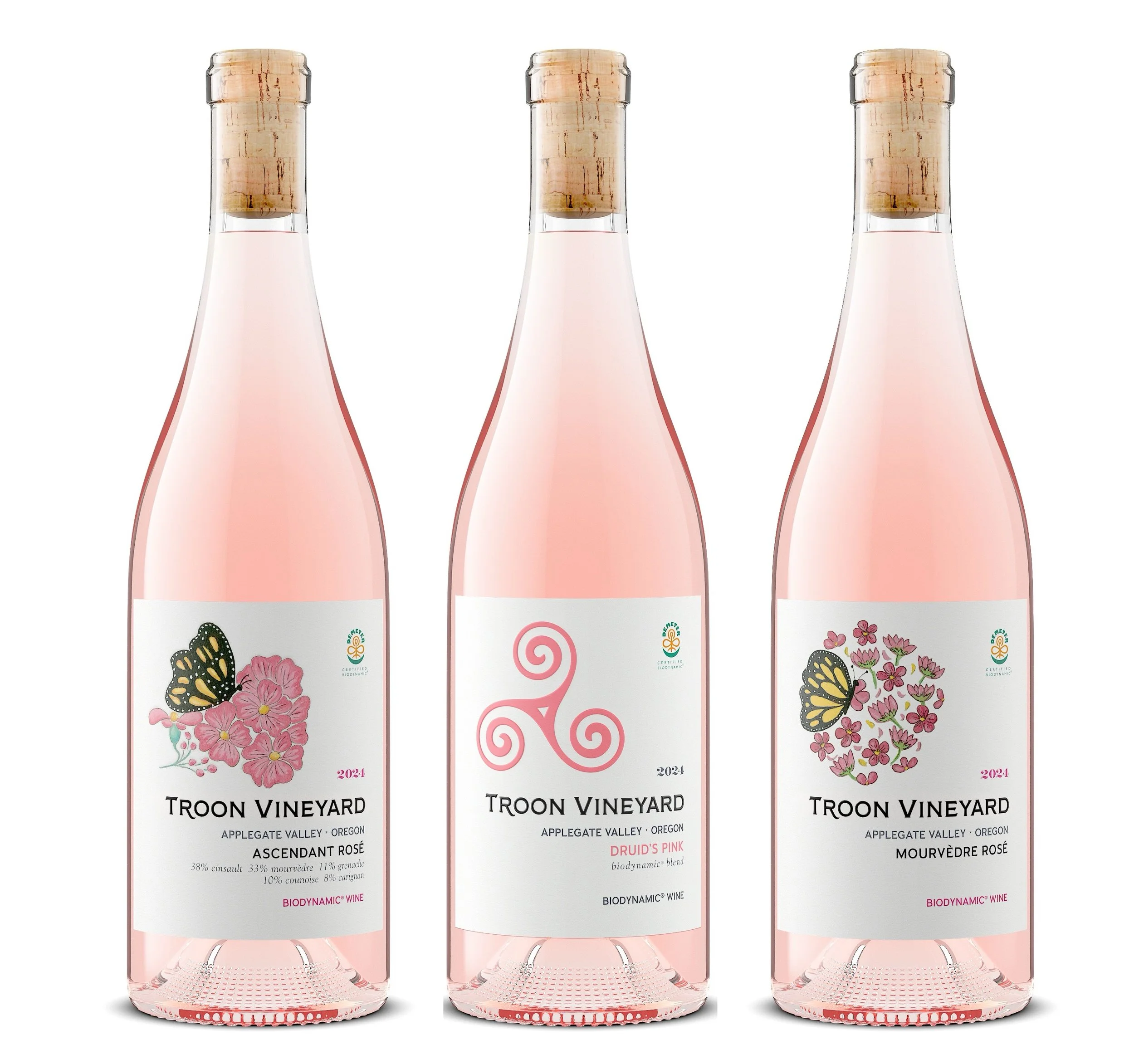
Troon’s Rosé Wine Program by Winemaker Nate Wall
As with many things, at Troon Vineyard we make rosé a little differently than many in the wine industry. Our rosé wines are all made with intention, with grapes specifically grown and harvested for rosé production. At Troon, these wines are not rushed through the vinification and bottling process, as is the case with most rosés in the market, but are made with the same care and patience we use for all of our wines. The result is rosé wines that are not hurried through the process, typically bottled much later and also released later, have colors ranging across the pink color spectrum all the way from a light copper/salmon color to more typical pink/purple hues, and have the potential to age and develop increasing depth and complexity over many years.
A rosé by any other name
The English language has borrowed most of the words we use to describe wine from the French. Like most types of wine, we use the word rosé to indicate the wine's color - in this case, often on the pink color continuum. In French, “blanc” means white, “rouge” means red, and “rose” means pink; however, somewhat uniquely here, the French refer to pink wines as “rosé” not rose, which actually is more like saying that the wine is “pinked” - basically, a wine that has “become pink”.
Rosé wines achieve their color due to the fact that they are created when “red” wine grapes are vinified like white wines (fun fact: the French would call these red grapes “noir”, which actually means black, not red - “noir” grapes make “rouge” wines in French). Red wines are made by fermenting the entire berries, and sometimes stems, for an extended period of time - typically several weeks. During this time, the color (and tannins) from the grape skins (and seeds and stems in the case of tannins) are extracted into the fermenting wine, resulting in a darker red to purple color and a tannic texture common in red wines. White wines are rather different - after the white grapes are harvested, they are loaded fairly directly into the press, where over the course of an hour or two the grapes are pressed for their juice. This juice is then fermented, creating white wine. A rosé wine typically happens when red grapes are harvested and loaded into the press, and then the juice from those red grapes is fermented, just as is the case for white wines.
Rosé wines with intention
At Troon, the grapes for our rosé wines are farmed and harvested with the intention of producing rosé wines. This means that the grape chemistry at harvest is chosen to produce the most balanced and complex rosé wines possible from our site. This is not always the case with rosé wines. Although many rosé wines are made as described above, with red grapes harvested and treated in the cellar much like white grapes, another process is sometimes used to create rosé. “Saignée” (again, stealing the word from the French), refers to the “bleeding” of juice from red grapes. This process involves removing a small amount of juice (typically 5-10%) from a red grape fermenter at the very beginning of fermentation and using it to make rosé. The dejuiced red fermentation now concentrates the extracted color and tannins into a smaller volume of liquid, intensifying the resulting red wine, which was the actual goal of the saignée in the first place. But the juice that was removed is far from ideal for rosé production - it was picked at harvest chemistries meant for red wines. This generally means that it has much riper, jammier flavors, more tannin, more sugar (and thus higher potential final alcohol level), and much less acidity than if those same red grapes had been grown and harvested specifically for rosé wine. This juice often requires quite a bit of cellar manipulation, including various additives and processes, to turn it into something palatable as a rosé wine. So while it may outwardly look similar to a more intentionally made rosé and bear the same name on the label, this wine will be quite different from a rosé made with intention.
Rosé “season”??
Most rosés generally have the fastest production cycle of almost any other wine - harvested in the fall, then rushed through alcoholic fermentation (and sometimes a portion of malolactic fermentation), before being fined and filtered and then bottled in January or February for almost immediate release. The main reason for this is financial - getting the wine into bottle and out of the winery frees up a lot of space, cuts down on the overhead associated with storing wine (typically in temperature-controlled areas), and frees up employees to work on other winemaking activities. It also starts getting payments from distributors early, which helps offset the major costs incurred during the busy harvest season. And while all of these reasons are valid, you’ll note that none of them really relate to the quality of the wine being produced.
Provence, in the south of France, is the global powerhouse of rosé production, accounting for over 40% of all rosé wine produced worldwide. This means that Provence sort of sets the schedule for what is often referred to as “rosé season” - release the wine in late winter or just at the start of spring, and sell through everything by the end of summer. This has been rosé’s calendar for several decades now, and it does sync up with how and when rosé wines are typically purchased and enjoyed - but how much of the synchronicity is due to the release schedule itself? A chicken-and-egg sort of question here.
Ageability
Wines vinified for immediate consumption often contain several additives to stabilize and preserve them for quick release. They may be enjoyable enough when young, but they lack the structural integrity needed for aging, and in fact often start fading and falling apart rather quickly. Rosés made with more patience and intention, focusing on quality over speed, can age, and will continue to develop depth and complexity over time. These ageable rosés can still be enjoyed during “rosé season” (spring and summer), but will typically be at least one vintage older than the flood of current-release rosés from Provence. Ageable rosés are also much more likely to be enjoyed outside of rosé season, such as during the fall and winter. The added complexity of these rosés, often having savory, herbal, and mineral qualities beyond just fresh and fruity, means they can pair much better across a wide range of cuisines and situations than the simpler, perhaps more hedonistic, fast-turn rosés.
At Troon Vineyard, our ageable rosés are the result of dozens if not hundreds of decisions in the growing, harvesting, and vinification of the wines. We select specific grape varieties from specific blocks, sometimes even from specific rows within a block, that experience and intuition have told us will make the best rosé wines. We then farm these selections year-round with the express purpose of bringing the grapes to the ideal point for rosé at harvest. When we do make that picking decision, this means that the grapes do not require any manipulation or additives in the cellar to alter their inherent character - we have grown the wine in the vineyard.
Once the grapes destined for rosé arrive at the winery, several decisions must be made about how to press them to extract the juice that will become the rosé. We grow twenty different grape varieties at Troon, and six of them (grenache, mourvèdre, cinsault, carignan, counoise, and eventually tibouren) - often from multiple clones and grown in multiple blocks - are used in rosé production. Each of these varieties requires something different from us to reach its own particular balance point. Do we foot tread the grapes before pressing? How much time do we leave the juice on the skins? How much time in the press? At what time and pressure does the press cycle? Do we make any cuts between press fractions (free run, light press, hard press), and do we then handle each press fraction separately? These all have subtle (and not-so-subtle) effects on the look, smell, taste, and chemistry of the resulting juice. And this juice contains all the flavor and aroma precursors, in varying amounts and ratios, that will be utilized by the yeast during fermentation, where the true character of the wine is created.
But there’s more. Do you ferment each juice separately, or do you co-ferment any of the varieties together? What type of fermentation vessel or vessels do you use? Size, shape, material (neutral oak, concrete, amphorae), temperature - these all play a role. How about malolactic fermentation - full, partial, or none? Sulfur dioxide - when is it added, and how much is used? The answers to these questions all play directly into the quality and ultimate ageability of the final wines.
At Troon, our rosés are generally fermented in neutral oak barrels in our rather cool, temperature-controlled barrel room (usually around 55 F). All of our wines, including our rosés, undergo full malolactic fermentation. This means that all malic acid is naturally converted to lactic acid, slightly lowering acidity while producing a fuller, rounder mouthfeel and creating a more microbially stable wine. We also delay adding sulfur dioxide for as long as possible. In fact, most other “typical” rosés have already been bottled and are on the shelf for purchase before any of our rosés have received even a drop of sulfur. This means our rosés spend much longer unprotected from oxygen, or rather, protected by their own lees and the slow, steady release of carbon dioxide from a longer, slower fermentation and malolactic process. This gives the wine chemistry time to adapt to the presence of some oxygen, with oxidizable components settling out and absorbed by the lees while still in the barrel. This leaves the final wines much less affected by the ravages of air exposure during aging, and gives them the stability to age gracefully and develop added complexity.
Color
The color of rosé wines is perhaps more diverse than in any other category of wine. There are several reasons for this. First off, the juice of the vast majority of grapes is colorless - all of the color compounds are found in the skins. This is why you can create what are known as Blanc de Noirs - this literally translates to “white from blacks”, which is creating a white wine from “black” (red) grapes by handling and pressing the grapes in a gentle many such that no color is extracted into the juice.
Rosé wines are made from many different grape varieties, and they all inherently have different forms of pigmented phenolic compounds (mainly anthocyanins/anthocyanidins), that provide color. This can also vary to some degree by vintage. How much of these compounds is extracted from the skins before and during grape pressing, and how stable they are within the wine matrix, will determine the final color of the wine.
The amount of skin contact the grapes receive before and during pressing off the juice, and the length and pressure of the pressing itself, will dictate the starting color potential of the juice. Different choices made in fermentation, malolactic fermentation, and oxygen management will all contribute to either color stabilization or color loss. Sometimes, a decision is made to enhance the flavor or complexity of a rosé may lead to a lighter color. Because color in wine is largely cosmetic, at Troon we prioritize quality and ageability over color density. Thus, you will find that the color of all Troon Vineyard wines may vary from vintage to vintage, but this is probably most noticeable in our rosé wines.
I think this is why the French might use the term rosé rather than rose for these wines - the important thing in making them is not the final color (rose), but rather the process. So while a blanc wine will be white, and a rouge wine will be red, rosé wines can span a broad spectrum of colors from almost completely white to almost as dark as a red wine. At the end of the day, what makes a rosé a rosé is not the color, but the process and the intention.